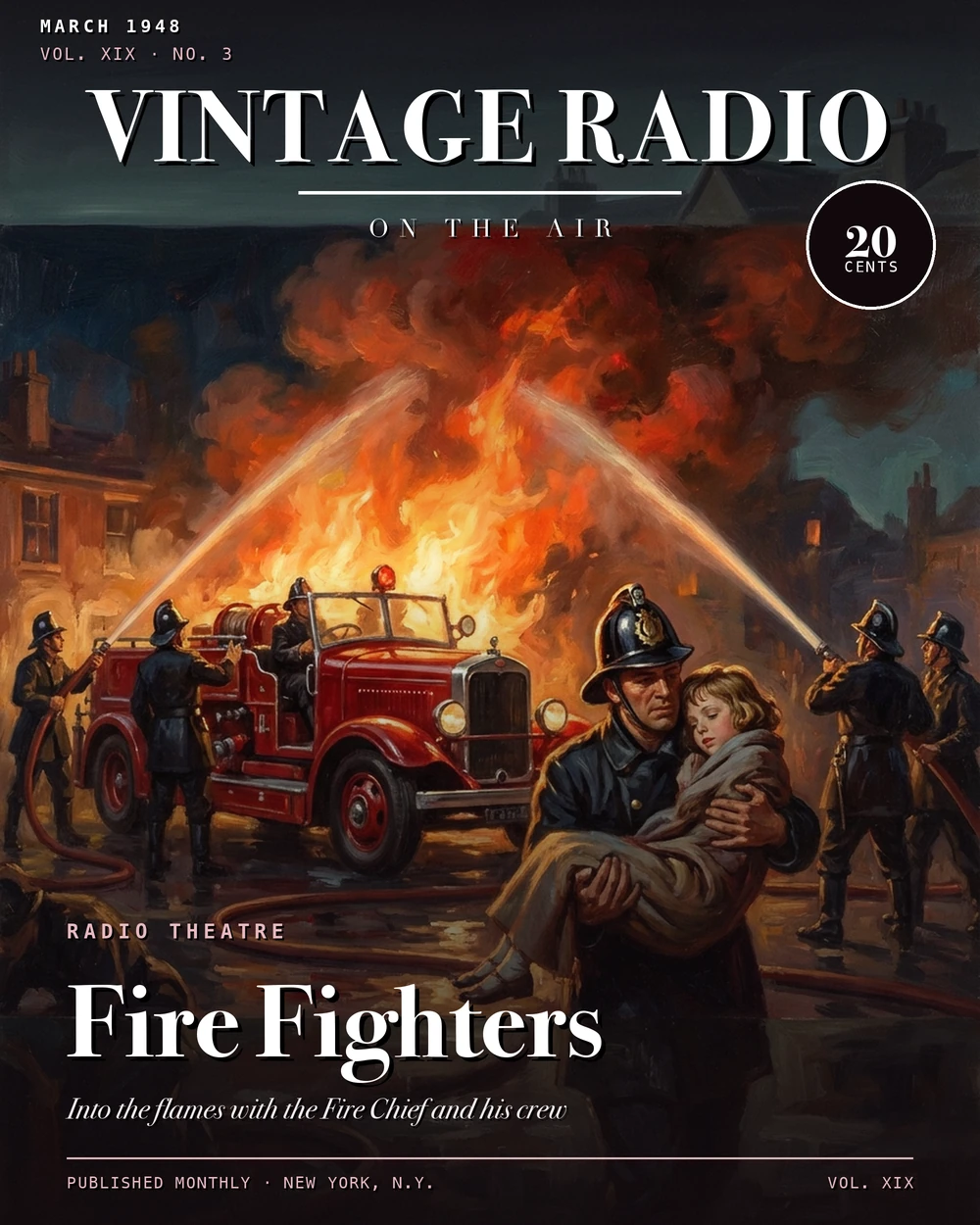
Fire Fighters
The Show Behind the Siren
Fire Fighters was not a program that happened to mention fire safety — it was built around the mission from the ground up. William F. Holland, owner of a Cincinnati advertising firm he'd founded in 1937, looked at fire statistics in the late 1940s and decided radio could do something about them. He wrote and produced the series specifically to address what he saw as widespread fire safety problems, then arranged with NBC's Radio-Recording Division in New York City to put the thing on tape. The result was a syndicated children's series that aired coast-to-coast — in Portland, Omaha, Washington D.C., and on WCPO in Cincinnati during early primetime — beginning in 1948 and running into the early 1950s.
Each episode ran roughly 12 to 15 minutes in a Monday-through-Friday strip format, which made it easy for local stations to slot it in and easy for young listeners to follow. The pacing and length fit a younger audience, but the material — drawn from actual case histories of real fire departments — gave the show a factual grounding that kept it honest. Stories covered forest fires, waterfront fires, industrial and oil fires, arson cases, and unusual fire scenarios, all routed through a fictional station that made the drama personal and immediate.
The series opened the same way every time: "Five Bells stand by all stations… Attention all districts, a five alarm fire… Five bells, move in immediately… Let's go, FIRE FIGHTERS! Presenting Fire Fighters, the true to life story of our unsung heroes…" That call became the show's signature — a reliable jolt that told listeners exactly what they were in for.
How It Was Made and Who Made It
The scripts came from writers Walter Covell and Frank Jones, who structured the series around Tim Collins, a rookie firefighter who had returned home from World War II service and wanted a spot in the same department where his father had served. His father had died in the line of duty when Tim was still a boy, which gave the character a personal stake beyond simple ambition. The episode titles map out his arc clearly: "Tim Collins' First Day," "Tim Doesn't Get His Appointment," "Tim Gets Appointed to the Fire Department" — a slow build through institutional hurdles that gave young listeners something to follow week to week.
Playing opposite Tim's story was Fire Chief Bob Cody, the steady authority figure at the center of the department. Cameron Prud'Homme took the role and made it the anchor of the series. Prud'Homme, born in 1892, was a character actor with deep stage roots who would eventually earn a Tony nomination in 1958 for his work in New Girl in Town on Broadway. On Fire Fighters he brought that stage presence to a character who had to be credible as a commanding officer while also, at the end of every episode, stepping outside the story to talk directly to listeners about fire safety. That fourth-wall break was built into the format — Chief Cody addressed the audience personally, making the fire safety message feel less like a public service announcement and more like straight talk from someone who knew the subject.
The rest of the cast included Lyle Sudrow alongside Prud'Homme in the leads, with supporting players Don Gardner, Ethel Evertt, Peter Griffith, John Lazer, and Elizabeth Morgan filling out the station and the community around Tim Collins.
The Storylines and the Sound
The episode catalog reveals a show that thought in arcs rather than isolated incidents. Jimmy Collins — likely a relative, given the shared surname — turns up in a subplot where he's suspected of turning in false alarms and then cleared: "Is Jimmy Collins Turning in False Alarms?" leads eventually to "Jimmy Not Guilty of False Alarms." Tim himself ends up in danger midway through the run, trapped and fighting for air during a fire, prompting Chief Cody to order a rescue — "Tim is Trapped Fighting for Air" and "Chief Cody Orders Men to Rescue Tim" run into "Tim and the Watchman are Saved" and a wrap-up titled "How the Fire Started." Even Tim's own home catches fire in one story, the kind of dramatic irony that kept a young audience engaged.
The sound design was central to all of this. Crackling flames, blaring sirens, and the frantic audio of firefighting activity made the action legible to an audience that couldn't see anything. In a 12-minute strip aimed at children, sound effects did a lot of heavy lifting — they established location, raised stakes, and signaled danger before a single line of dialogue confirmed it. Producing the recordings at NBC's Radio-Recording Division in New York gave the show access to facilities that could render those effects cleanly.
The Junior Firefighters Club and Its Real Results
Holland didn't stop at the radio signal. Young listeners were invited to join the Junior Firefighters Kids Club, where completing fire safety tasks earned rank and recognition. A child who correctly answered fire safety questions became a "Rookie Firefighter" and received a red firefighter's hat in the mail. More effort earned the title of "Junior Fire Chief." For a younger audience in the late 1940s, that kind of tangible reward connected the radio lessons to real behavior.
Whether it worked is not just a matter of anecdote. In 1949, Cincinnati Fire Chief Barney J. Houston formally commended the William F. Holland Company for the program, crediting it as directly responsible for a 20% reduction in false alarms in the city. Houston also noted that fire inspectors had found fire hazards removed from the homes of Junior Firefighters club members — meaning children had gone home and applied what the show taught them. That's a measurable outcome, not a promotional claim.
The Cincinnati Fire Museum eventually created a dedicated exhibit titled "Firefighters: The Radio Program That Saved Lives," which speaks to how the city understood the show's legacy. Some sources also credit the series with helping to move popular usage from "fireman" toward the more inclusive term "firefighter," though the show's role in that shift is harder to quantify.
What Survived and What It Was
The full run is documented at 195 episodes in a certified set released in March 2022. Earlier circulations had put the episode count closer to 140, but the complete picture is larger. Sponsors over the run included the Grandma Cookie Company and various others, which was typical for syndicated programming of this kind — a show distributed to multiple markets picked up different local advertisers rather than carrying a single national sponsor.
Fire Fighters is classified in old-time radio catalogs as a children's series, which is the right frame for it. It wasn't a general-audience adventure drama — it was a youth program with an education mission, produced by an advertising man who had identified a public problem and decided radio storytelling was the right tool to address it. The drama of burning buildings, trapped firefighters, and rescue operations was real enough to hold a child's attention, and Chief Cody's direct address at the end of each episode ensured the lesson landed. That combination — genuine drama plus explicit instruction — was the show's design, and by at least one concrete measure, it delivered.